It's natural to want to care for stray cats that hang around your home. It may be easy to simply put an extra can of cat food outside for a cat that shows up at your back door. What should you feed a stray cat that you’re caring for? How can you ensure the food doesn’t spoil and how can you care for strays without creating tension with your neighbors?
Here's what you need to know.
What Should You Feed a Stray Cat?
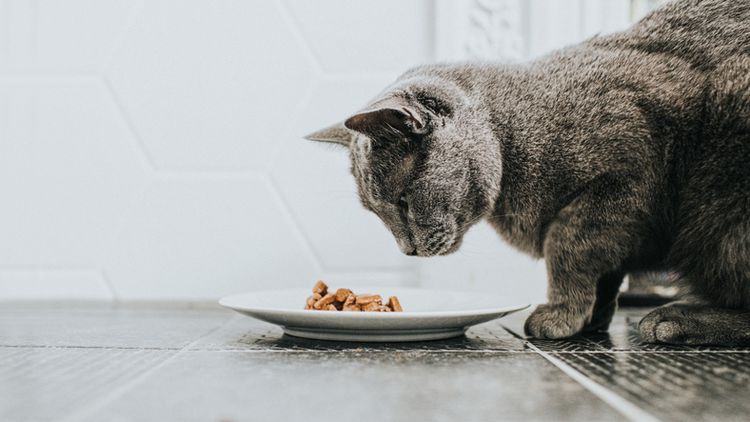
Feeding stray cats can be more involved than simply leaving out a dish of dry kibble or a plate of canned food. It can sometimes be difficult to determine if a stray cat is a senior or an adult, but regardless, according to Alley Cat Allies, most adult cats eat 5.5 oz of canned food and 2 oz of dry a day. If you’re feeding just dry food, one adult cat will eat about 1/2 C dry food a day. Kittens (that are weaned from mother’s milk) may require more food a day, and they should be fed kitten food specifically.
The decision to feed your cat dry food and wet food can depend on the weather where you live and the time of year.
In the summer, when temperatures and humidity are high, canned food may spoil more rapidly. Dry food is less likely to attract bugs in the summer months and wet food may dry out quickly. In this type of weather, if you do opt to feed canned food, add extra water to help prevent it from drying out and pick up anything left uneaten after 30 minutes. Uneaten dry food should be picked up after it's been left between 30 and 45 minutes. Picking up uneaten food not only prevents stray cats from accidentally ingesting spoiled food, but it can also deter wildlife and/or bugs from getting to the food.
Additionally, there are specific ant-proof bowls and feeding stations that can be a good investment in warmer climates. Alternatively, you can pour a line of either baking soda or food-grade diatomaceous earth around the food (and water) bowls. Believe it or not, ants won’t cross over this barrier.
In the winter, cats may require slightly more food for added energy. Although there may be no bugs to worry about, uneaten food should still be picked up to prevent the attraction of wildlife and to prevent the food from freezing. There are heated electric bowls that can also prevent freezing. These can be especially useful for a stray cat’s water source.
Where Should You Feed a Stray Cat?
Cats are habitual animals. They will come back to the same spot at the same time if they found food and water there before. Alley Cat Allies recommends feeding stray cats somewhere discreet that is accessible to your residence but away from busy roads or neighbors as much as possible. Additionally, creating feeding stations, which can be something as simple as a plastic storage container with an entry hole cut into the side, can keep the food and water safe from the elements. Cats also tend to feel more safe when they are up high, so placing food and water bowls on ledges, benches, fences, etc. may make a nervous, shy stray cat feel more comfortable.
Stray cats should also be fed at the same time(s) every day and in the daylight, when able. Feeding in the daylight hours can help deter wildlife from eating the food instead of the cat(s) for whom it is intended. As daylight savings approaches, feeding 10 minutes earlier or later, depending on spring or fall, can help stray cats acclimate better to the time change.
If a stray female cat you are feeding has kittens, you shouldn’t be worried about her abandoning her kittens if you start feeding them. She may not warm up to you as quickly, but even if you don’t see her, she won’t leave her kittens behind.
Feeding stray cats can be a hot topic for some. Some homeowners associations (HOAs) forbid it and some neighbors may not be happy to have feral cats on their property. Feeding stray cats, though, can help them feel more safe around you and this, in turn, can help you monitor their health. Providing food for strays may also make it easier to trap them for neutering/spaying and vaccination, which are the most important contributors to their long-term welfare and help keep the neighborhood cat population in control.